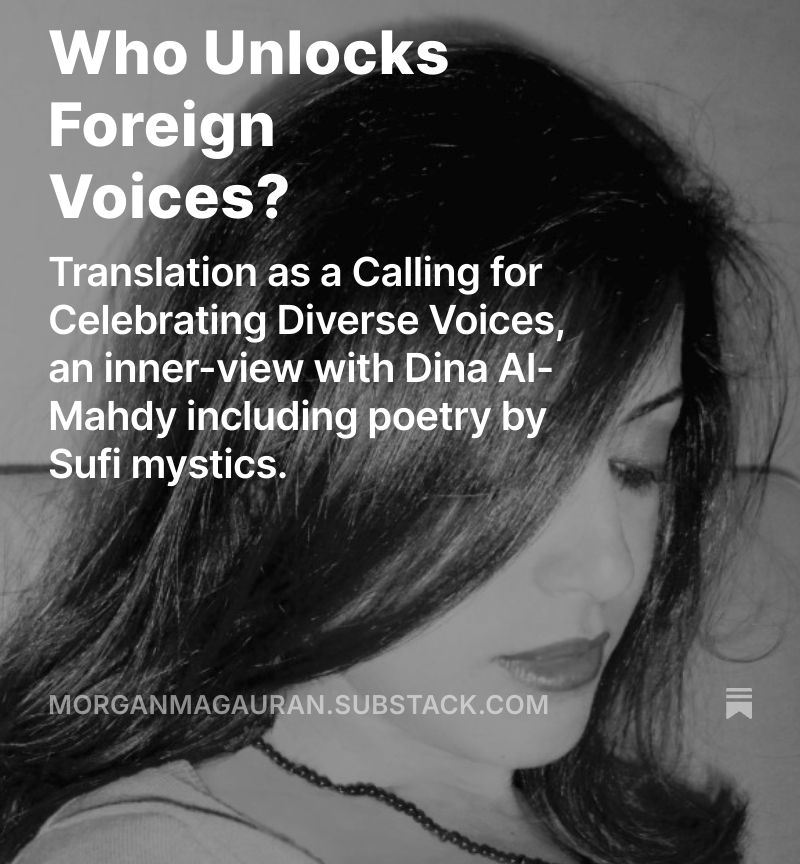
Translation as a Calling for Celebrating Diverse Voices, an inner-view with Dina Al-Mahdy including poetry by Sufi mystics.

May 27, 2025
Welcome to inner-views, a seasonal series of interviews with artists, thought leaders, and practitioners whose work is featured in the Rumored Woman Book Series. These conversations explore the correspondence between our inner and outer worlds.
Morgan: Dina, thanks so much for taking the time for this Spring’s inner-view. A few years ago, our paths crossed in cyberspace when I discovered your translation of Rumi’s poem “The Guest House” on your blog, A Journey into My World, where you reflect on literature, positive psychology, and empowerment. In reading more about your work, I learned of your extensive translation expertise with UNESCO, UNITAR, Egypt’s National Center for Translation, and UN Women as part of your commitment to women’s rights and sharing empowering narratives about Egyptian women. Readers can learn more about Dina’s award-winning background here.
“The Guest House” appears in the final chapter of Return, Book Two in the Rumored Woman Series. The poem is below for folks unfamiliar with Jalal al-Din Rumi’s poetry.
This human is a guest house.
Every morning, a new guest arrives.
A joy, a grief, a despair, some momentary awareness comes, as an unexpected
visitor. Welcome and entertain them all!
Even if they’re a crowd of sorrows, who violently sweeps your house empty of
its furniture.
Still treat each guest honorably.
They maybe clearing you out for some new delight.
The dark thought, the shame, the malice.
Meet them all at the door laughing, and invite them in.
Be grateful for whoever comes, because each has been sent as a mentor from
beyond.
Sometimes, I wonder if this poem unconsciously catalyzed the Rumored Women Series because it counsels us to welcome all that arises in our inner lives, not only the joys, also the grief, despair, and sorrows. Recently, I learned of a friend entering hospice. My first reaction was NO, he’s too young, his boys deserve a father for more decades to come, his leadership is more essential now than ever—a crowd of sorrows has been knocking at my door, and writing this, I realize it’s time to let them in.
Do you have a personal relationship with this poem that you might be willing to share?
Dina: Absolutely. “The Guest House” has long held a sacred place in my heart. I first encountered the poem during a challenging period in my life, and its message struck me like a gentle yet powerful wave. It invited me to embrace every emotion, even the ones I was resisting—fear, loss, uncertainty—with compassion and curiosity. Rumi’s words reminded me that these emotional visitors, however difficult, carry their own wisdom and purpose. Translating this poem became a form of healing. It allowed me to welcome my own sorrows, not as obstacles, but as teachers. I return to it often, especially when life feels chaotic. It grounds me in the understanding that every experience, however painful, can be a portal to deeper growth.
Morgan: What inspired you to translate poetry, specifically Rumi, and have you translated other poets, living or deceased?
Dina: My journey into translating poetry, particularly the works of Rumi, was motivated by my deep admiration for the profound wisdom and beauty in his words. Rumi’s poetry transcends cultural and linguistic boundaries, resonating with themes of love, spirituality, and human connection that are universally relevant. As a translator, I aim to convey not only the literal meaning of Rumi’s verses but also the emotional essence that inspires readers.
The experience of translating Rumi is akin to stepping into a sacred space where the nuances of human experience are richly layered. My academic background—including a Master’s degree in Translation Studies from the University of Cambridge—equips me with the skills to navigate the intricacies of language and emotion inherent in poetry. I’ve also translated works from other poets, both living and deceased, and I find that each poet brings a unique worldview that challenges me to adapt my approach to translation.
Through this process, I’m reminded of the beauty in diversity and the power of language to unite us across different cultures. Each translation project not only enhances my understanding of the original work but also allows me to share these timeless messages with others, empowering them through the gift of literature.
Morgan: What’s it like to enter the creative current of another, in this case, an ancestor and world-renowned poet?
Dina: Entering the creative current of an illustrious poet like Rumi is both exhilarating and humbling. It’s as if I’m engaging in a timeless dialogue with a soul who has traversed the depths of human emotions. Each line I translate becomes a bridge to the past, allowing me to feel the heartbeat of Rumi’s thoughts and the cultural context from which they arise.
This connection deeply influences my own creative process. I often find myself diving into a meditative state as I work, which helps me immerse fully in Rumi’s imagery and philosophy. It’s an exploration of the self and the universe—the intertwining of hearts and minds through the act of translation. I am not merely a vessel translating words; I am actively participating in the flow of ideas and emotions that have echoed through centuries.
Translating Rumi also serves as a reminder of the timeless relevance of his messages, reinforcing my commitment to the preservation of cultural heritage and literature. It inspires me to think about how we can uplift voices from the past to build a more inclusive future. Many writers and poets deserve to be amplified, just as Rumi’s voice has been for centuries.
Morgan: Regrettably, I only speak English. How many languages are you fluent in?
Dina: I’m fluent in three languages: Arabic, English, and French. Each language unlocks a different window into the world for me. Arabic is my mother tongue, rich with poetic heritage; English gives me access to a vast landscape of global literature and dialogue; and French adds a lyrical dimension to my understanding of philosophy and art. Being multilingual not only enhances my ability to translate but also deepens my appreciation for the nuances and cultural rhythms embedded in each text.
Morgan: When you’re engaged in translation, how, if at all, does it affect you, or your inner life?
Dina: Translation has a profound and transformative impact on my inner life. It doesn’t merely occupy my thoughts while I am engaged in the work; it permeates my daily experiences and subconscious mind. There are times when I find myself dreaming of themes related to my translation projects—often reflecting the emotional layers of the poetry and the broader implications of the texts. Rumi’s explorations of love and spiritual connection, for example, have inspired me to reflect on my own relationships and the essence of compassion in my daily interactions.
While translating, I often ponder the delicate balance between faithfulness to the original text and the need to express its spirit in another language. This meditative approach leads me to insights not only about the text but also about the human experience as a whole. I tend to carry the themes of my work into conversations and reflect on how they relate to current issues, particularly those concerning cultural heritage.
Furthermore, the stories I translate often shape my worldview. They challenge me to cultivate empathy and mindfulness, as well as to approach others with an open heart. I strive to incorporate the compassion I learn through translation into my advocacy work and personal interactions. As a result, translation is not just a professional endeavor; it’s a way of living that aligns with my values and aspirations.
Morgan: Clearly, translation is more of a calling than a profession for you. Are there projects you prefer to work on?
Dina: Translating literature, particularly poetry, enriches my life both personally and professionally. It’s a journey of continuous learning, growth, and a deepening connection to the diverse tapestry of human thought and experience. I look forward to sharing this journey with others, fostering understanding and appreciation for the art of translation, and celebrating the voices of women and underserved communities along the way.
Morgan: I’m so grateful that you and other translators offer me access to the artistry and wisdom that lives in other cultures; it enriches my life. One last question, is there a body of literature or poetry that you hope to translate and make share more broadly available? Maybe by making your inner wish list transparent, a request might find its way to you.
Dina: Yes, there are several. One that’s especially close to my heart is the body of work by overlooked female Arab poets, both contemporary and classical. Many of these voices have been historically underrepresented or lost in translation, and I believe their perspectives offer a vital contribution to global literature.
I’m especially passionate about amplifying the voices of female Sufi mystics—women whose spiritual insight and poetic expression rival those of their male contemporaries but whose legacies are often hidden. For example:
Rābiʿa al-ʿAdawiyya (8th century, Iraq): Widely considered one of the earliest and most influential female Sufi saints, her poetry and prayers radiate divine love, detachment, and longing for union with the Divine.
A’isha al-Ba’uniyya (15th–16th century, Damascus): A prolific Sufi poet and scholar, she authored works in both prose and poetry on divine love, mysticism, and ethics. Her Principles of Sufism is one of the few extant mystical works by an early Muslim woman.
Fatima al-Nisaburi (11th century, Persia/Greater Khorasan): While little of her work survives, she is often cited in classical sources as a figure of wisdom and spiritual discipline.
In the contemporary context:
Nadya Agrawal and Fadwa Tuqan, though not strictly Sufi, explore themes deeply aligned with mysticism—love, loss, and the search for spiritual belonging.
Etel Adnan, a Lebanese poet and mystic artist, infused her poetry and prose with philosophical and mystical currents, often exploring themes of light, time, and transcendence.
Salma Khadra Jayyusi, while better known as an editor and translator, also carried forward a literary and spiritual legacy through her work on Arab women’s writing.
These voices are spiritually rich, emotionally resonant, and culturally significant. I hope to bring more of their work into translation so they may be read, studied, and celebrated on a global scale. There’s a quiet revolution waiting in their words—a soft, persistent call to the sacred that deserves to be heard.
Morgan: May it be so. I’d love to conclude with a translation of one of the female Sufi mystics if you have one already completed.
Dina: Yes, I’ve translated “I Love You with Two Loves” by Sufi poet Rābiʿa al-ʿAdawiyya, it feels beautifully in tune with the spirit of our exploration. Interestingly, this particular poem was also sung by the legendary Egyptian singer Umm Kulthum in a 1960’s film about Rābiʿa al-ʿAdawiyya, which brought even more emotional depth to the words. I hope it resonates with you as much as it does with me, the song is linked in my blog post.
I came to know love through Your love and I’ve closed my heart to all but You.
I whispered to You who sees the secrets of hearts while none of us see You.
I have loved You with two loves: A selfish love and a love that is worthy of You.
In my selfish love, I remember You and You Alone.
But in that other love, You lift the veil and let me feast my eyes on You.
Hence, I do not deserve the praise for this or that, Yet the praise in both is for
You.
I have two ways of loving You: A selfish one, and another that is worthy of You.
I have two ways of longing for You: one for the farness from You,
And another for the closeness I feel when I am secluded in Your Refuge.
In my first longing, I shed a stream of tears for the long distance between me
And You.
But in that other longing, the light of my life has dimmed in Your Splendor.
Despite my anguish, I am not complaining of my love
I am contented with whatever You have predestined for me in Your Guidance.
Morgan: Wow, gorgeous. Dina, please accept my heartfelt appreciation for your work in the world and the time you’ve taken to participate in this inner-view.
Read the full piece on: https://morganmagauran.substack.com/…/who-unlocks….
 Dina Al-Mahdy: Award-winning Writer and Translator